Press release · Brooklyn, NY · September 2026
A Brooklyn dad built a free app to help families take the subway without unexpected stairs.
StrollerNYC uses live MTA elevator data to plan step-free subway trips, helping parents navigate around reported outages before they reach the station.
It started with one family's everyday plans.
For someone traveling alone with a baby and a stroller, a broken elevator can change the whole day. A straightforward subway trip can become an unexpected detour, a search for someone willing to help, or a decision to turn around.
The uncertainty starts before leaving home: Can I get to the platform? Can I make the transfer? Will I be able to get out at the other end?
Julio Servan, a Brooklyn-based product designer and new father, works in big tech and has extensive experience building digital products and designing AI-powered experiences. For StrollerNYC, his motivation was closer to home: helping his wife feel confident taking their baby on the subway independently, meeting friends and making plans without worrying about unexpected stairs.
He saw this moment in AI as an opportunity to put his experience to work beyond his day job, building something useful for other parents in the city. Created independently on nights and weekends, StrollerNYC grew from one family's everyday need into a free tool for New Yorkers who need a step-free way to get around.
“This started as an act of love for my wife and our baby. I wanted her to feel confident taking him on the subway on her own, without worrying about unexpected stairs. That meant more freedom for our family, and I wanted to share that possibility with other parents in the city.”
What it looks like
1/5 Plan a trip: home and daycare saved, one tap to plan from where you are
One family's problem. A citywide need.
274
babies a day
100,213 births in NYC in 2024
31%
of stations accessible
155 of 493, end of 2025 — the other 69% are stairs
~1M
New Yorkers with a disability
city estimate
More than 100,000 births in one year
New York City recorded 100,213 births in 2024, according to the sum of NYC Health's provisional quarterly figures — roughly 274 babies a day.
For thousands of families navigating the city with strollers, step-free access is part of everyday life.
Fewer than 1 in 3 stations accessible
At the end of 2025, New York City's accessibility report counted 155 accessible stations out of 493 across the subway and Staten Island Railway.
That means nearly 7 in 10 stations were not listed as accessible.
The MTA is continuing to expand accessibility across the network, but its long-term commitment targets 95% station accessibility by 2055.
A baby born in 2026 will be 29 years old by then.
Families need to get around today.
And accessible on paper is not the same as accessible right now. From the MTA's live equipment feed, at this moment:
389
ADA elevators tracked
every one, refreshed every minute
7
out of service right now
as of 1:13 AM ET · live
7
stations with a broken elevator
right now — each one an unexpected staircase
Live figures come from the MTA's public equipment and outage feeds — the same data the app plans with. Reload on a bad day and the numbers get worse.
Around 1 million New Yorkers live with a disability
New York City estimates that around one million residents live with a disability.
Their individual needs vary, but the scale shows why step-free transportation is not only a parenting issue. It affects wheelchair users, older riders, people with limited mobility, travelers with luggage, and many others trying to move through the city independently.
An elevator at the station is only part of the answer.
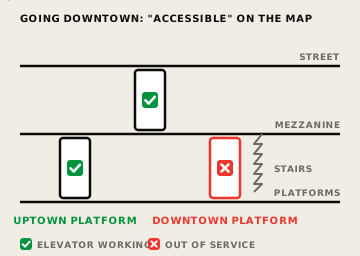
Knowing that a station has an elevator does not necessarily tell someone whether that station will work for their particular journey.
Some stations provide step-free access only in one direction or only to certain platforms. And even at an accessible station, the specific elevator needed for a trip may be temporarily out of service.
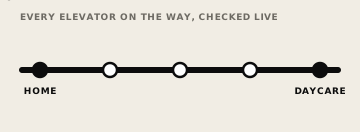
StrollerNYC looks at the journey differently.
It checks the elevators needed to enter the subway, make transfers and exit, accounting for which platforms those elevators actually serve.
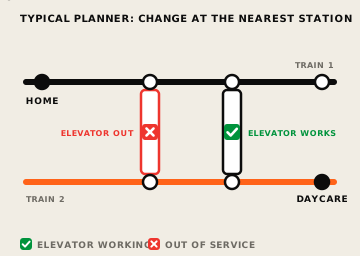
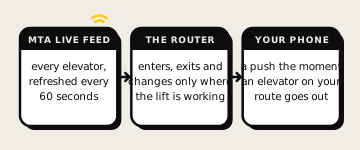
It then combines that information with the MTA's latest reported elevator status when selecting a route.
The question is not simply whether a station has an elevator. It is whether the elevators your journey depends on are reported to be working.
Elevator information is refreshed every minute, and riders can also enable notifications when an elevator on a saved route goes out of service.
If an outage makes a station unsuitable for a trip, StrollerNYC can look for another step-free option and account for the additional walking needed.
The goal is simple: give people useful information before they arrive at an unexpected staircase.
Built around a stroller. Useful beyond it.
StrollerNYC began with one family and one stroller, but step-free routing can be useful to many more people.
That includes wheelchair users, older riders, people with limited mobility, parents with young children, and travelers carrying heavy luggage.
The app does not replace accessible infrastructure, and it does not attempt to address every accessibility need.
Its purpose is much more focused:
Help people understand whether they can make their subway journey without stairs before they leave home.
For Julio, the goal is not simply to generate a better route on a screen.
It is to give people a little more confidence to make plans, leave home and move around New York independently.
Built independently with modern technology
StrollerNYC was designed and built independently by Julio outside of his full-time work.
His professional background spans digital product design, AI-powered experiences and technology products at large tech companies.
At a moment when AI is making it possible for individuals to build and launch ambitious products much faster, Julio decided to use those tools and his product experience to solve a very real problem his own family was facing.
What began as something for his wife and baby became a product he could share with other families across New York.
About StrollerNYC
StrollerNYC is a free iPhone and web app created independently in Brooklyn.
It uses MTA open data to provide step-free subway routing informed by reported elevator status.
- Created by
- Julio Servan
- Based in
- Brooklyn, New York
- Available on
- iPhone and the web
- Price
- Free
- Focus
- Step-free NYC subway routing using live elevator information
- Affiliation
- Independent project; not affiliated with the MTA
StrollerNYC has no advertising and does not require an account to plan a journey.
When a rider chooses to use their current location, those coordinates are used to calculate the trip and are not retained. Optional sign-in allows riders to sync saved places across devices.
Press materials and contact
Screenshots, product images and explanatory graphics are available for editorial use.
Please credit StrollerNYC when reproducing graphics or product imagery.
- Screenshots — the gallery above; tap one to enlarge and click again to download.
- Masthead — SVG, animated where applicable
- A station is not one accessible thing — SVG, animated where applicable
- Same trip, two plans — SVG, animated where applicable
- How it works — SVG, animated where applicable
- App icon — 512×512 PNG
For interviews, product demonstrations, questions about the project or additional press materials, contact Julio through the press contact form.
Website: StrollerNYC.com
Press page: StrollerNYC.com/press